Augment Code Review: Serious AI Coding for Large Codebases, or Just More Hype?
TL;DR
Use this article to move into a better next click
- Augment Code targets real engineering teams, not toy demos. Here’s where its context engine, agent workflow, and enterprise focus actually stand out.
- Augment Code is most relevant for IDE Plugins + Agentic Coding, and the directory profile adds pricing, tradeoffs, and alternatives.
- Before you commit, compare it with Cursor and Claude Code.
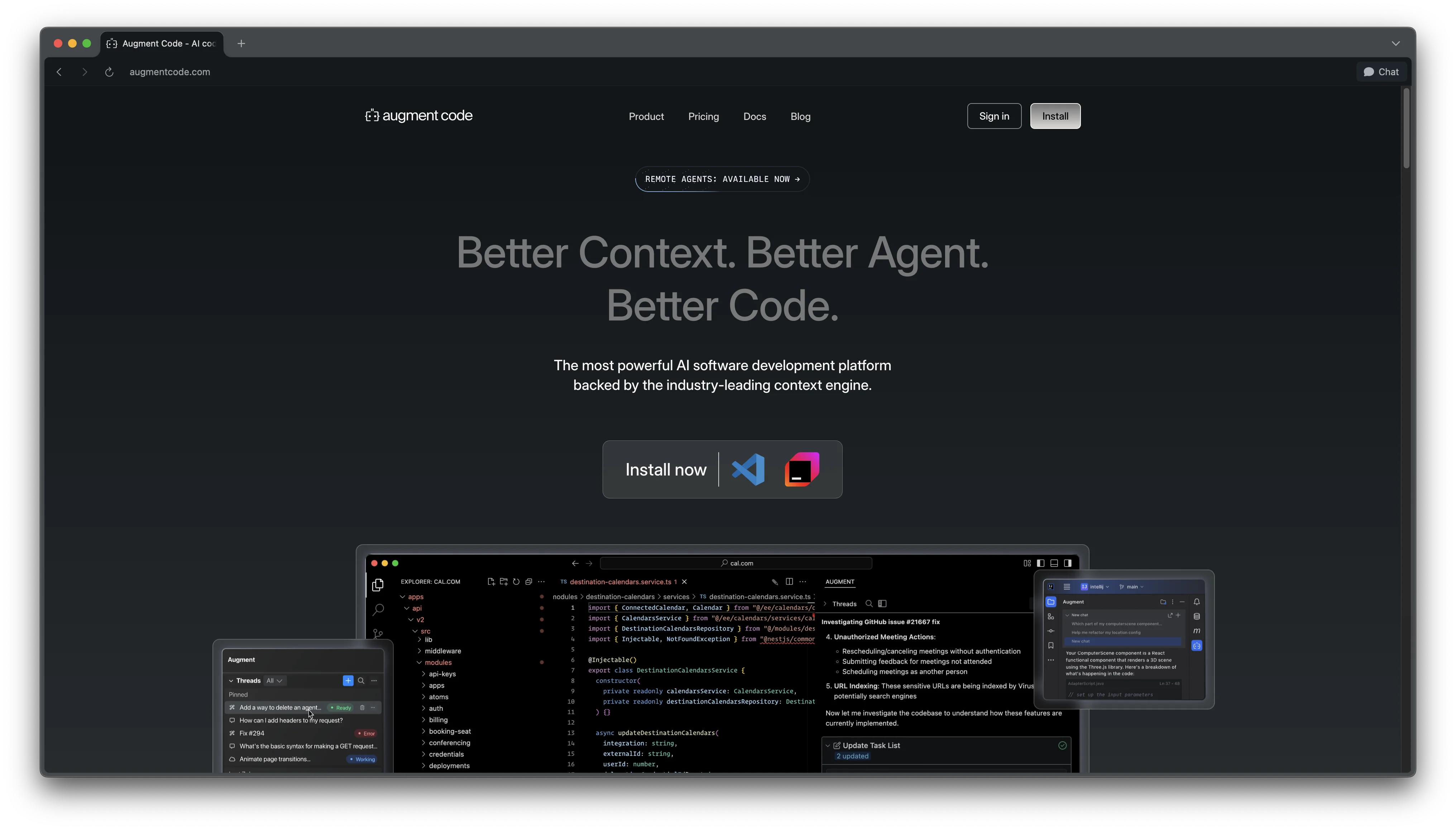
Most AI coding tools look impressive in a demo and fall apart the moment you throw a real codebase at them.
That’s the actual bar Augment Code is trying to clear. It isn’t pitching itself as a cute autocomplete toy or a weekend-hack assistant. The whole product is aimed at teams working inside large, messy, high-context repositories where naive code generation usually creates more damage than speed.
So the useful question isn’t “can Augment write code?” Nearly every serious tool can do that now.
The real question is: does Augment Code stay useful when the project gets complicated?
Keep the tool in view
Open Augment Code before you forget it
The profile page adds pricing, pros, cons, and internal alternatives without throwing you straight to a vendor pitch.
What Augment Code Actually Tries to Sell
Augment positions itself around one central idea: context quality determines code quality.
That’s not just marketing fluff. It’s the right battlefield. Once model quality starts converging across tools, the differentiator stops being raw generation and becomes:
- how much of your codebase the tool can actually understand
- whether it can preserve architectural context across sessions
- how well it avoids shallow, locally-correct but globally-stupid changes
- whether it works across the places developers already work
On its current product surface, Augment is leaning heavily into:
- a Context Engine for whole-codebase understanding
- agents that can operate across IDE, CLI, and code review flows
- support for VS Code and JetBrains
- a push toward team and enterprise workflows, not just solo developers
That alone makes it more ambitious than the “VS Code wrapper + chatbot” crowd.
Where Augment Code Looks Strong
1. It is built for codebase-level work, not snippet theater
The strongest part of Augment’s pitch is that it’s optimized for your entire stack — code, dependencies, architecture, and project history — rather than just the file in front of you.
That matters because most AI coding failures are not syntax failures. They’re context failures.
The model writes something that:
- duplicates an existing abstraction
- ignores internal conventions
- breaks adjacent systems
- misses prior decisions hidden elsewhere in the repo
If Augment’s context layer is genuinely better in practice, that’s a real advantage. For larger teams, that’s way more important than flashy one-shot demo output.
2. The product is not trapped inside a single UI
Augment explicitly shows up in multiple developer surfaces:
- IDE
- CLI
- code review
- related workflow surfaces like Slack and docs/resources
That’s smart. Developers don’t work in one box anymore. A tool that only feels good inside a chat panel eventually becomes friction.
If the same system can carry context across implementation, review, and coordination, that’s the sort of integration that can actually change team velocity.
3. It is clearly targeting professional teams
A lot of “AI coding” products are still basically prosumer toys pretending to be developer infrastructure.
Augment is taking the opposite route. The site language, workflow framing, and enterprise/security positioning all suggest it wants to sell into serious engineering orgs. That usually means stronger pressure on:
- reliability
- access controls
- security review
- auditability
- consistent output quality
That doesn’t guarantee excellence, but it does mean the product is solving for a more serious problem than “make junior devs type less.”
Where You Should Be Skeptical
1. Every tool now claims “deep context”
This is the new AI coding cliché.
Everyone says they understand your whole codebase. Everyone says they’re better on large repositories. Everyone claims some kind of memory, context graph, or agent architecture.
So Augment should not get credit just for saying the words. It only deserves credit if it consistently performs better when asked to:
- refactor across multiple modules
- respect existing architecture boundaries
- reuse existing code instead of regenerating everything
- make changes that survive code review without embarrassment
That is where the product either earns its premium positioning or gets exposed.
2. Enterprise polish can come with workflow drag
Tools optimized for bigger teams often add process friction.
That may be worth it if you’re working in a large production codebase. It may not be worth it if you’re a solo builder trying to ship quickly.
So if your default mode is:
- hack fast
- prototype aggressively
- rebuild often
- accept some mess
then Augment may feel heavier than tools built for pure speed.
That’s not a flaw. But it is a fit question.
3. Benchmark claims are never enough on their own
Augment’s official site leans on performance comparisons and claims that agents can outperform humans on some tasks when context quality is high.
Interesting? Yes.
Sufficient proof for buying into a workflow? No.
Benchmarks can be directionally useful, but production adoption lives or dies on boring questions like:
- does it help on your repo
- does it reduce review churn
- does it create fewer regressions
- do senior engineers actually trust it after two weeks
- can it fit into an existing stack without political drama
If the answer to those is weak, benchmark slides won’t save it.
Compare before you switch
Pressure-test Augment Code
Use the alternatives block on the tool page before you leave for the official site. That one extra step usually saves you a bad pick.
Augment Code vs Cursor and Claude Code
This is the comparison most people actually care about.
Versus Cursor
Cursor is often better at feeling fast, lightweight, and immediately useful.
Augment’s case against Cursor is basically this:
- better whole-codebase understanding
- stronger enterprise posture
- more durable context handling
- more serious multi-surface workflow design
If you’re a solo indie hacker, Cursor may still feel more natural.
If you’re maintaining a larger production system with real complexity, Augment has a more defensible story.
Versus Claude Code
Claude Code is brutally effective if you like terminal-native workflows and want raw agent power without much ceremony.
Augment’s angle is more structured and productized:
- stronger integrated experience across surfaces
- more explicit context-engine positioning
- more enterprise/team packaging
- less “wire-it-yourself,” more “use the system we built”
That can be better or worse depending on your preferences.
If you want maximum control, Claude Code still has a real edge.
If you want a more opinionated system for teams, Augment becomes more compelling.
Who Should Actually Consider Augment Code
Augment Code makes the most sense if you are:
- working in a large or long-lived codebase
- part of a team that cares about architecture consistency
- tired of AI tools making locally-smart, globally-dumb edits
- trying to use agents in a workflow that includes implementation, review, and coordination
- evaluating tools for a team, not just for yourself
It makes less sense if you are:
- just prototyping side projects
- mostly working in tiny repos
- optimizing for raw speed over control
- unwilling to trade some simplicity for more structured context handling
Final Take
Augment Code is interesting for the right reason: it is trying to solve the hard part of AI coding instead of the flashy part.
The hard part is not generating code. The hard part is generating the right code inside a real codebase with history, conventions, dependencies, and consequences.
That’s why Augment is worth watching.
But don’t romanticize it. This category is full of inflated claims, and “deep context” has already become an overused slogan. The product only matters if it helps strong engineers move faster without lowering the quality bar.
If your work lives in serious repositories and team workflows, Augment Code looks like a legitimate contender.
If you just want the fastest dopamine hit from AI-assisted coding, there are lighter tools that may fit better.
That’s the honest split.


