Open Code Review 2026: CLI, Codex Plugin, Pricing & Alternatives
TL;DR
Use this article to move into a better next click
- A practical Open Code Review assessment of its hybrid architecture, CLI, Codex integration, pricing, privacy tradeoffs, and alternatives.
- Open Code Review is most relevant for CLI Tools + Agentic Coding, and the directory profile adds pricing, tradeoffs, and alternatives.
- Before you commit, compare it with CodeRabbit and Qodo.
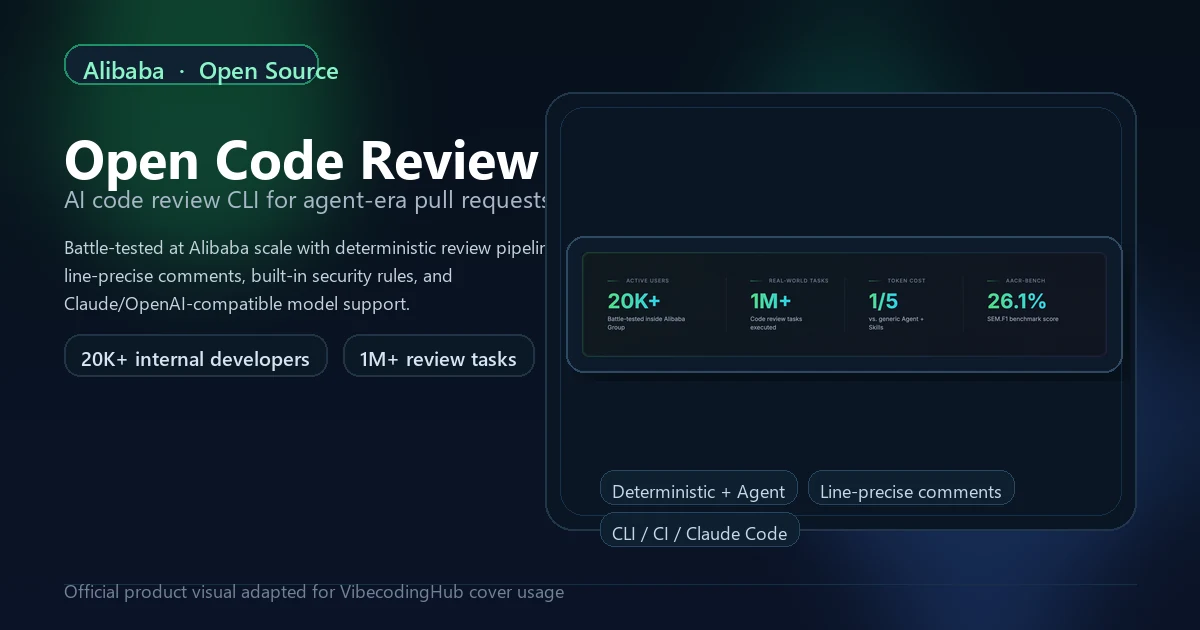
Open Code Review is an open-source AI code review CLI from Alibaba. It reviews Git diffs, gathers repository context with read-only tools, and returns structured comments tied to specific lines. It can also scan complete files when there is no useful diff.
The product is more opinionated than a generic "review this pull request" prompt. Deterministic code decides which files to review, how to group related changes, which rules apply, and where comments belong. An LLM agent handles contextual investigation and defect reasoning inside those boundaries.
The short verdict: Open Code Review is worth evaluating if agent-generated changes are arriving faster than your team can review them and you want an inspectable, scriptable review layer. It is not a replacement for human approval, and its quality, privacy, and operating cost still depend on the model endpoint and rules you configure.
Quick Verdict
| Question | Practical answer |
|---|---|
| Best for | Developers and platform teams that want local or CI-based AI review with configurable models and rules |
| Not ideal for | Teams that want a fully managed service with no model, CI, or review-policy setup |
| Official site | open-codereview.ai |
| GitHub | alibaba/open-code-review |
| License | Apache-2.0 |
| Core price | Free and open source; model usage and CI infrastructure are separate costs |
| Version checked | v1.9.6, published August 18, 2026 |
| Public signal checked | About 20.7k GitHub stars and 1.5k forks on August 19, 2026 |
| Main strength | A review-specific pipeline around file coverage, rules, context gathering, and line-level comments |
| Main weakness | Results still depend on model tool use, configuration, and careful human verification |
| Closest alternatives | CodeRabbit, Qodo, Hunk, Plannotator, and review workflows inside general coding agents |
What Open Code Review Actually Does
Open Code Review supports several review scopes:
- workspace mode covers staged, unstaged, and untracked changes;
- range mode reviews the changes between a branch's merge base and its target;
- commit mode reviews one commit;
- full-file scan mode audits files or directories without relying on Git history.
The CLI can print human-readable output or structured JSON for another agent or CI job. A preview command shows which files would be included or excluded before any model tokens are used. Review sessions are saved locally and can be inspected in a browser viewer.
This is review infrastructure, not a pull-request host. It does not merge code, make a model infallible, or turn an automated comment into proof that a change is safe. Its value is providing a repeatable process around model-based review.
Keep the tool in view
Open Open Code Review before you forget it
The profile page adds pricing, pros, cons, and internal alternatives without throwing you straight to a vendor pitch.
Why the Hybrid Architecture Matters
Open Code Review separates predictable review mechanics from tasks that require semantic judgment.
The deterministic part filters unsupported or excluded files, groups related files, selects path-specific rules, dispatches bounded per-file work, and resolves final comment positions. The agent can then read relevant files, search the codebase, inspect related changes, and report issues through structured tool calls.
That division addresses real failure modes in ad hoc AI review: silently skipping files, losing the connection between a comment and its line, or changing behavior because a prompt was phrased differently. It also makes the workflow easier to inspect with preview output, session history, and explicit rules.
There are still limits. A compatible model must support native tool calling. Large or unusual diffs can exceed context limits, comment positioning can fail, and a per-file subtask can stop early. The official FAQ also notes that a run may exit successfully when some file subtasks fail, as long as at least one succeeds. CI users should therefore inspect warnings and structured output rather than treating exit code zero as a complete review guarantee.
Installation and First Review
The documented prerequisites are Git 2.41 or newer and Node.js 18 or newer for the npm path. Install the CLI with:
npm install -g @alibaba-group/open-code-review
Configure and test a model endpoint:
ocr config provider
ocr config model
ocr llm test
Then inspect the file selection before paying for a review:
ocr review --preview
ocr review
The project also publishes release binaries for Windows, macOS, and Linux. For automation, JSON output and agent-oriented stdout make it possible to pass results into another tool without scraping terminal decoration.
Start with a small repository and a representative pull request. Check which files were selected, whether comments are anchored correctly, how many warnings appear, and whether the configured model follows the tool protocol reliably before making the review a required merge gate.
Coding-Agent and CI Integrations
The official repository publishes integrations for Claude Code, Codex, Cursor, OpenCode, QCA Forward, and agents that can load portable skills. These integrations keep Open Code Review focused on review mechanics while the host coding agent can present findings, investigate them, or apply a selected fix.
There are two execution models:
- OCR-managed review: Open Code Review calls the configured LLM endpoint itself.
- Delegation mode: the host coding agent performs the model reasoning while Open Code Review supplies file selection and rule resolution.
Delegation mode can avoid a separate Open Code Review API key, but it does not make model usage free. The host agent still has its own subscription, usage limits, and data-handling terms.
The repository also includes CI examples for GitHub Actions, GitLab CI, GitFlic CI, and Gerrit. CI adoption should be gradual. Begin with non-blocking output, measure false positives and missed issues, tune path rules, and only then decide whether a finding should block a merge.
Pricing Reality
Open Code Review is free under the Apache-2.0 license. There is no required product subscription for the CLI, rules, viewer, agent plugins, or CI examples.
The practical cost comes from the configured model and the infrastructure around it. OCR-managed reviews can consume API tokens across planning, context retrieval, tool calls, and optional compression. CI runners and any self-hosted model endpoint also carry operating costs. Delegation mode shifts model use to the host agent rather than removing it.
File filters, preview mode, concurrency settings, and focused project rules can reduce waste. The cheapest useful setup is not necessarily the weakest model; a model that struggles with tool calls or takes many rounds to finish may cost more while producing less reliable output.
Benchmark Claims: Useful, but Not Independent Proof
Alibaba publishes AACR-Bench, a code review benchmark built from 50 open-source repositories, 200 pull requests, 10 programming languages, and 1,505 annotated issues reviewed by more than 80 senior engineers. The project reports higher precision and F1 than a general-purpose agent using the same underlying model, along with lower token use and faster reviews.
The important caveat is in the project's own result: recall is lower. Open Code Review deliberately favors fewer noisy findings over finding every possible issue. The benchmark is also published by the project team, so it should guide an evaluation rather than replace one.
Run the same pull requests through your current process and compare actionable findings, false positives, missed defects, latency, and cost. A review tool that wins a benchmark can still be a poor fit for a repository with different languages, generated code, framework conventions, or risk tolerance.
Compare before you switch
Pressure-test Open Code Review
Use the alternatives block on the tool page before you leave for the official site. That one extra step usually saves you a bad pick.
Privacy and Security Tradeoffs
The CLI runs locally, but local execution does not mean all code stays local. The official FAQ says diffs and any snippets read by review tools are sent to the LLM endpoint you configure. Session files and rules stay on the machine, while optional telemetry is disabled by default and does not export prompt or response content.
There is no built-in secret-redaction step. Exclude sensitive files, keep credentials out of source and diffs, and review provider retention terms before sending private code. If you use a self-hosted model, verify its tool-calling quality rather than assuming local inference is automatically compatible.
Treat review comments as untrusted suggestions. Confirm the cited code, reproduce the failure path, and keep tests, static analysis, security tooling, and human review in the merge process. A confident line-level comment can still be wrong.
Open Code Review Alternatives
CodeRabbit or Qodo: Consider a managed review service when fast onboarding, pull-request comments, team dashboards, and vendor support matter more than local control. Open Code Review is more attractive when open-source code, model choice, and custom review plumbing are priorities.
Hunk: Choose Hunk when the primary problem is making agent-written diffs easier for a human to inspect in the terminal. Hunk is a review interface; Open Code Review adds model-based issue discovery and rules.
Plannotator: Plannotator is a better fit when you want a visual approval layer for plans, documents, and diffs. Open Code Review is narrower and more automation-oriented.
A general coding agent: An existing agent may be enough for occasional reviews in small repositories. Open Code Review becomes more compelling when file coverage, repeatable rules, structured output, and CI integration need to be consistent across many changes.
Who Should Use Open Code Review?
Use Open Code Review if you:
- want a dedicated review pipeline instead of another free-form prompt;
- need local CLI, JSON, agent-plugin, or CI entry points;
- value Apache-2.0 licensing and configurable model providers;
- want previewable file selection and path-specific review rules;
- can evaluate warnings, false positives, missed issues, and model costs;
- will keep human judgment and conventional quality gates in the loop.
Skip it for now if you:
- want a hosted product with no model or CI configuration;
- cannot send repository context to the available model endpoints;
- need an automated reviewer to guarantee complete coverage;
- use models without reliable native tool calling;
- are unwilling to tune exclusions, rules, and merge policy for your codebase.
Bottom Line
Open Code Review is a credible open-source answer to a growing problem: coding agents can produce changes faster than teams can review them carefully. Its strongest idea is not simply adding an LLM to a diff. It is wrapping the model in deterministic file selection, review rules, context tools, concurrency controls, and line-positioning logic.
That structure makes it more defensible than an improvised review prompt, but it does not remove the model's limitations. The safest adoption path is a non-blocking trial on known pull requests, followed by explicit measurement of missed defects, false positives, warnings, latency, and model cost.
Start with the Open Code Review tool page, then verify current behavior in the official repository, latest release, architecture documentation, integration guide, and privacy FAQ.