Compound Engineering
MIT-licensed workflow plugin that gives Claude Code, Codex, Cursor, OpenCode, and other coding agents a plan-work-review-compound engineering loop.
Do not bounce yet
Read the fit check, compare one alternative, then decide whether the vendor page is still your best next click.
Quick Verdict
Fast fit check before you leave the page
Make the fit call first. Vendor pages are good at selling, but they rarely tell you where the product is a bad match.
- Developers and teams using Claude Code, Codex, Cursor, OpenCode, or multiple coding-agent clients on real repositories
- Engineering leads standardizing agent-assisted work around requirements, implementation plans, review, CI, and durable knowledge capture
- Teams evaluating autonomous pull-request workflows with explicit artifacts and human review gates
- Compound Engineering is an instruction and orchestration layer, not a secure execution sandbox, CI system, or proof that an agent obeyed every gate.
- The full 32-skill surface can add ceremony, context cost, and setup complexity when a repository only needs planning or review discipline.
- Autonomous lfg-style flows can commit, push, open pull requests, and react to CI, so permissions and branch protections need deliberate least-privilege configuration.
Compare Next
Take one more internal step before the vendor pitch
This is where visitors usually jump out too early. Read one deeper take or open one alternative so the next click is informed instead of impulsive.
Alternative profile
Superpowers
MIT-licensed skills framework and software-development methodology that makes Claude Code, Codex, Cursor, OpenCode, Pi, and other coding agents follow spec, TDD, review, and branch workflows.
Alternative profile
Agent Skills
MIT-licensed engineering skill pack that gives Claude Code, Codex, Cursor, Gemini CLI, OpenCode, and other coding agents repeatable senior-engineer workflows.
Alternative profile
Trellis
Open-source multi-platform AI coding workflow CLI for structuring specs, tasks, memory, and parallel agent work across tools like Claude Code, Codex, and Cursor.
Compound Engineering is worth tracking because fast code generation can make a codebase harder to change when plans, review findings, and solved problems disappear after each agent session. Every's plugin packages a repeatable brainstorm, plan, work, simplify, review, and compound loop as installable skills for Claude Code, Codex, Cursor, OpenCode, and other coding-agent clients. Its value is not another model endpoint; it is the attempt to make each unit of agent-assisted engineering leave the next unit with better context.
Compound Engineering is Every's open-source workflow plugin for AI coding agents. It packages a six-step loop—brainstorm, plan, work, simplify, review, and compound—into installable skills for Claude Code, Codex, Cursor, OpenCode, and many other clients. The plugin can turn requirements into implementation plans, execute them with host-owned verification, run specialist code and document reviews, capture solved problems in repository documentation, and operate an optional hands-off lfg pipeline through commits, pull requests, CI monitoring, and repair. That makes it useful for vibe-coding teams that want each agent run to leave reusable engineering context instead of only another opaque diff.
Why Choose Compound Engineering?
Choose Compound Engineering when your team already uses coding agents and wants inspectable plans, reviews, solution notes, and pull-request gates instead of relying on one-off prompt reminders.
The cross-client install surface is unusually broad, with native or documented paths for Claude Code, Codex App and CLI, Cursor, OpenCode, Kimi Code, Cline, Grok Build, Devin, Copilot, Qwen Code, Pi, and more.
Its strongest differentiator is the final compound step: useful decisions and solved patterns can be written back into the repository so future sessions do not rediscover the same context.
Treat autonomous modes carefully. Skills can steer an agent through tests, commits, pull requests, and CI repair, but branch protection, sandboxing, least-privilege credentials, deterministic checks, and human review still provide the real safety boundary.
Key Features
Six-step engineering loop that moves coding agents through brainstorming, implementation planning, execution, simplification, review, and captured learning instead of jumping directly from prompt to diff.
32 maintained skills for strategy, ideation, planning, debugging, implementation, code and document review, browser testing, PR feedback, CI shepherding, handoffs, optimization, and knowledge compounding.
Native or documented plugin paths for Claude Code, Codex App and CLI, Cursor, OpenCode, Kimi Code CLI, Cline, Grok Build, Devin, GitHub Copilot, Factory Droid, Qwen Code, Pi, and Antigravity.
Repository-native artifacts such as plans and docs/solutions records, with configurable artifact roots for projects whose docs directory already contains tracked product content.
Optional lfg autonomous pipeline that can work through a plan, simplify and review code, run browser tests, commit, push, open a pull request, monitor CI, and attempt bounded repairs.
Active 3.x release cadence, public tests, security and privacy documentation, and a large repository history make the implementation inspectable rather than a marketing-only methodology.
Pros & Cons
- It addresses a real failure mode in vibe coding: each fast agent run can create more undocumented decisions and review debt unless the workflow deliberately captures reusable context.
- The workflow is concrete and reviewable—plans, solution notes, commits, pull requests, tests, and review reports leave artifacts humans can inspect.
- Cross-client packaging lets teams carry one methodology across several coding-agent surfaces instead of rebuilding equivalent prompt files for each tool.
- The repository has strong public traction, active releases, and substantial implementation depth for an agent workflow plugin.
- Compound Engineering is an instruction and orchestration layer, not a secure execution sandbox, CI system, or proof that an agent obeyed every gate.
- The full 32-skill surface can add ceremony, context cost, and setup complexity when a repository only needs planning or review discipline.
- Autonomous lfg-style flows can commit, push, open pull requests, and react to CI, so permissions and branch protections need deliberate least-privilege configuration.
- Independent production evidence is thinner than the GitHub star count: no direct Hacker News story was found during the audit, and repository popularity should not be mistaken for measured outcomes.
Detailed Use Cases for Compound Engineering
Use the brainstorm and plan skills to clarify requirements, inspect repository context, and produce an implementation-ready artifact before an agent edits code.
Use work, simplify, code-review, browser-test, commit, and PR skills when a well-scoped change needs explicit checkpoints from implementation through CI.
Use the compound step to turn debugging findings and successful patterns into repository documentation that future humans and agents can retrieve.
Install the same methodology across Claude Code, Codex, Cursor, OpenCode, and related plugin-capable agents when a team does not want its engineering process locked to one client.
Who Should Use Compound Engineering?
Developers and teams using Claude Code, Codex, Cursor, OpenCode, or multiple coding-agent clients on real repositories
Engineering leads standardizing agent-assisted work around requirements, implementation plans, review, CI, and durable knowledge capture
Teams evaluating autonomous pull-request workflows with explicit artifacts and human review gates
Agent workflow builders comparing Compound Engineering with Superpowers, Agent Skills, Planning with Files, Trellis, and repository-specific instruction systems
Perfect For
Standardize how Claude Code, Codex, Cursor, OpenCode, or another coding agent moves from ambiguous requirements to an implementation-ready plan and reviewed pull request.
Capture solved bugs, design decisions, and recurring repository patterns as durable solution notes that future agents can reuse.
Run specialist code and document review passes before merge while keeping application of suggested changes explicit.
Adopt a bounded autonomous delivery loop for well-specified, non-sensitive work where tests, permissions, CI, and human review are already strong.
Technical Details
Direct Competitors
Superpowers
Agent Skills
Planning with Files
Trellis
project-specific AGENTS.md or CLAUDE.md workflows
Similar Tools You Might Like

MIT-licensed skills framework and software-development methodology that makes Claude Code, Codex, Cursor, OpenCode, Pi, and other coding agents follow spec, TDD, review, and branch workflows.
MIT-licensed engineering skill pack that gives Claude Code, Codex, Cursor, Gemini CLI, OpenCode, and other coding agents repeatable senior-engineer workflows.
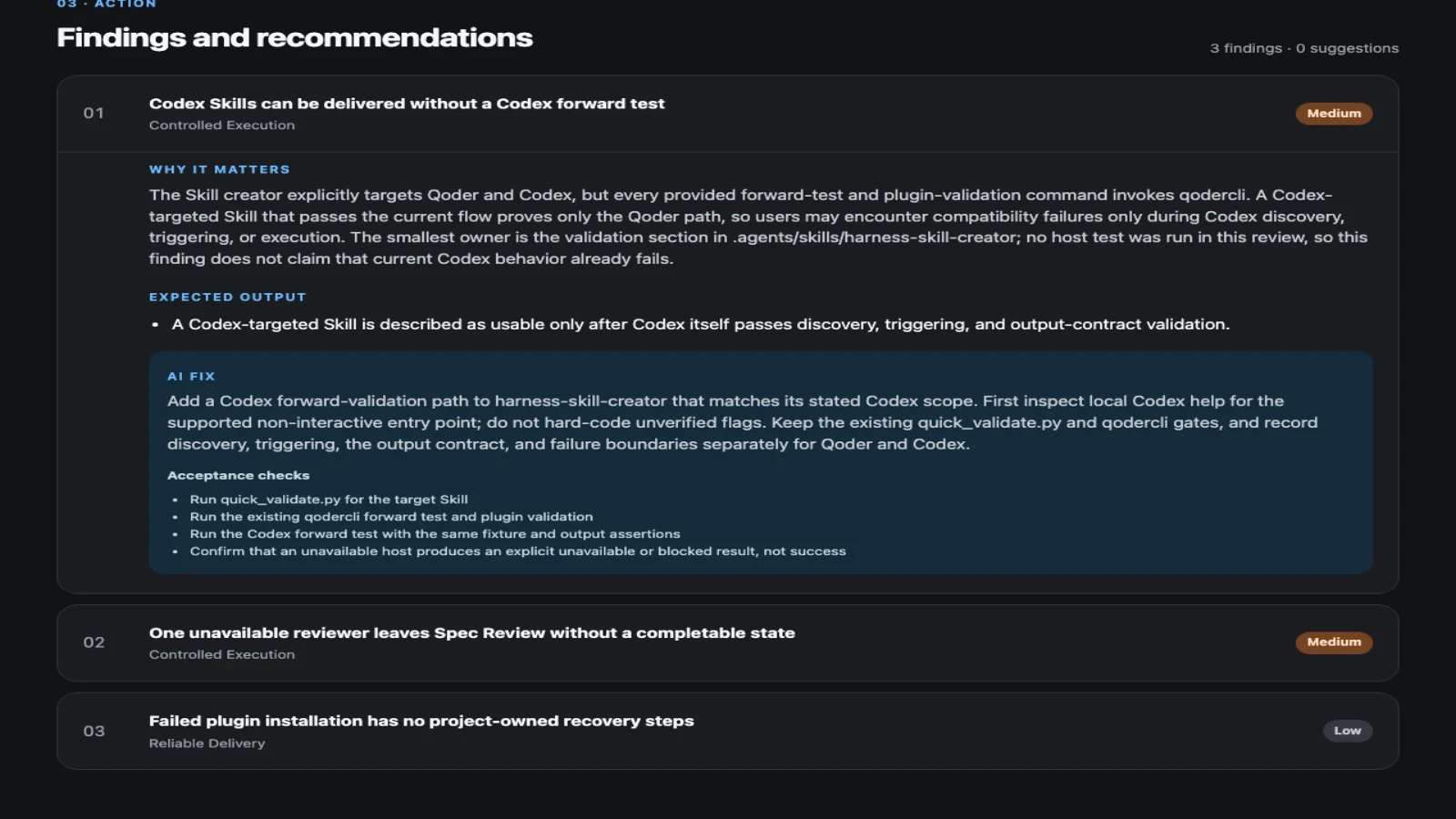
MIT-licensed workflow-inspection plugin that turns coding-agent project and session evidence into prioritized, verifiable improvements.
Alternative Tools to Consider
MIT-licensed skills framework and software-development methodology that makes Claude Code, Codex, Cursor, OpenCode, Pi, and other coding agents follow spec, TDD, review, and branch workflows.
MIT-licensed engineering skill pack that gives Claude Code, Codex, Cursor, Gemini CLI, OpenCode, and other coding agents repeatable senior-engineer workflows.

Open-source multi-platform AI coding workflow CLI for structuring specs, tasks, memory, and parallel agent work across tools like Claude Code, Codex, and Cursor.
Open-source persistent planning skill and plugin for coding agents that keeps task plans, findings, and progress on disk so work survives /clear, compaction, and crashes.

Apache-2.0 skill and plugin library for Claude Code, Codex, and Antigravity workflows across Google Cloud, Gemini, GKE, Firebase, and Google APIs.
Do one more comparison before you commit to Compound Engineering
Strong picks usually survive one more internal check. Read deeper, compare a neighbor, then leave for the vendor page if the fit still holds.