
Numbat
Open-source endpoint security CLI for monitoring, detecting, investigating, and optionally blocking risky AI coding-agent activity.
Do not bounce yet
Read the fit check, compare one alternative, then decide whether the vendor page is still your best next click.
Quick Verdict
Fast fit check before you leave the page
Make the fit call first. Vendor pages are good at selling, but they rarely tell you where the product is a bad match.
- Security and platform teams rolling out coding agents on developer endpoints
- Developers who need inspectable audit trails across multiple agent harnesses
- Incident responders reconstructing risky or unexpected agent actions
- The project is still v0.1.x, so interfaces, rule behavior, coverage, and deployment practices may change quickly.
- Coverage is uneven: current stores for OpenCode, Hermes, Cursor, Copilot, Cline, Goose, Kilo, Crush, and Kiro include deferred SQLite or WAL parsing work.
- Enforcement is not a universal sandbox: it only applies to supported synchronous pre-action hooks, depends on the host honoring the response, and can fail open in documented error cases.
Compare Next
Take one more internal step before the vendor pitch
This is where visitors usually jump out too early. Read one deeper take or open one alternative so the next click is informed instead of impulsive.
Alternative profile
ai-memory
MIT-licensed local memory server and CLI for carrying coding context, summaries, and handoffs across Claude Code, Codex, Cursor, OpenCode, and other agent clients.
Alternative profile
Code-Graph-RAG
MIT-licensed codebase knowledge graph and MCP server for structural search, natural-language exploration, data-flow tracing, and agent-assisted edits across mixed-language repositories.
Alternative profile
T3 Code
MIT-licensed control plane for running Claude Code, Codex, Cursor, Grok, and OpenCode threads from desktop, web, iOS, and Android clients.
Numbat is an open-source endpoint security layer for teams adopting coding agents faster than their existing security tooling can observe them. Instead of wrapping one model or IDE, it connects to supported agent hooks, telemetry, and stored session artifacts, normalizes the activity, and evaluates a shared set of detection rules locally. That makes it relevant to serious vibe coding environments where Claude Code, Codex, Cursor, OpenClaw, or other harnesses can run commands and touch sensitive developer systems.
Numbat is Perplexity's local-first security and forensics layer for coding agents. Its static Go binary discovers supported agent installations, normalizes live hooks, OTLP logs, and on-disk session artifacts into one event model, evaluates built-in or custom CEL rules, and can reconstruct timelines or build verifiable case bundles. Synchronous pre-action blocking is opt-in, limited to supported hooks, and disabled in every shipped rule by default. The important caveat is that Numbat is an early v0.1.x project: coverage varies by agent and surface, several current SQLite session stores are deferred, findings are rule matches rather than proof of compromise, and records can retain sensitive endpoint context even after redaction.
Why Choose Numbat?
Choose Numbat when you need one local event model across several coding-agent harnesses rather than separate ad hoc audit scripts for each tool.
Its read-only inventory and forensic scanning commands provide value before you install hooks or enable any blocking behavior.
The opt-in enforcement path is useful for carefully tested high-risk actions, but shipped rules remain monitor-only and host coverage must be checked first.
Do not treat it as a finished universal sandbox: the project is early, durable-store coverage has gaps, and sensitive output still requires strong access controls.
Key Features
Discovers supported local coding-agent installations and scans their on-disk session artifacts without executing commands found in those records.
Normalizes lifecycle hooks, generated plugins, OTLP/HTTP logs, and stored artifacts into versioned NDJSON events and findings.
Evaluates built-in and custom CEL rules, including multi-step sequences such as secret access followed by outbound transfer.
Supports opt-in pre-action denial on compatible agent hooks while keeping all shipped rules monitor-only by default.
Reconstructs per-session timelines and produces portable case bundles with SHA-256 manifests for investigation workflows.
Ships one static Go binary for macOS, Linux, and Windows on amd64 and arm64.
Pros & Cons
- Targets a real gap in agentic coding: cross-harness endpoint visibility and policy enforcement rather than another model-facing chat interface.
- Local detection, read-only scans, explicit sinks, and no outbound requests by default give operators meaningful control over sensitive records.
- The coverage matrix is unusually candid about which agent, host, artifact, hook, and enforcement surfaces actually work.
- Apache-2.0 code, schemas, rules, release checksums, and documented failure semantics make the implementation inspectable.
- The project is still v0.1.x, so interfaces, rule behavior, coverage, and deployment practices may change quickly.
- Coverage is uneven: current stores for OpenCode, Hermes, Cursor, Copilot, Cline, Goose, Kilo, Crush, and Kiro include deferred SQLite or WAL parsing work.
- Enforcement is not a universal sandbox: it only applies to supported synchronous pre-action hooks, depends on the host honoring the response, and can fail open in documented error cases.
- Records and case evidence can retain commands, paths, URLs, identity, and model context; redaction is not a declassification or DLP boundary.
Detailed Use Cases for Numbat
Use read-only discovery to see which supported agents and local data surfaces exist before changing hook configuration.
Normalize supported hooks, plugins, and OTLP logs into a common event stream for local CEL-based detection.
Scan stored session artifacts, build a timeline, and export a manifest-backed case bundle without executing recorded commands.
Promote selected operator rules to enforcement only after monitor-mode validation and verification that the target agent supports a synchronous deny path.
Who Should Use Numbat?
Security and platform teams rolling out coding agents on developer endpoints
Developers who need inspectable audit trails across multiple agent harnesses
Incident responders reconstructing risky or unexpected agent actions
Open-source evaluators comparing agent guardrails, telemetry, and endpoint controls
Perfect For
Inventory coding agents on developer laptops and identify which live and forensic surfaces can be monitored.
Monitor Claude Code, Codex, Cursor, OpenClaw, Hermes, and other supported harnesses with a shared event and rule model.
Investigate an agent incident by reconstructing prior sessions from local artifacts and exporting a verifiable case bundle.
Pilot narrowly scoped pre-action rules for dangerous commands after validating monitor-only findings and each host's enforcement semantics.
Technical Details
Direct Competitors
Invariant Guardrails
Semgrep
Socket
Endor Labs
Similar Tools You Might Like

MIT-licensed local memory server and CLI for carrying coding context, summaries, and handoffs across Claude Code, Codex, Cursor, OpenCode, and other agent clients.
MIT-licensed codebase knowledge graph and MCP server for structural search, natural-language exploration, data-flow tracing, and agent-assisted edits across mixed-language repositories.
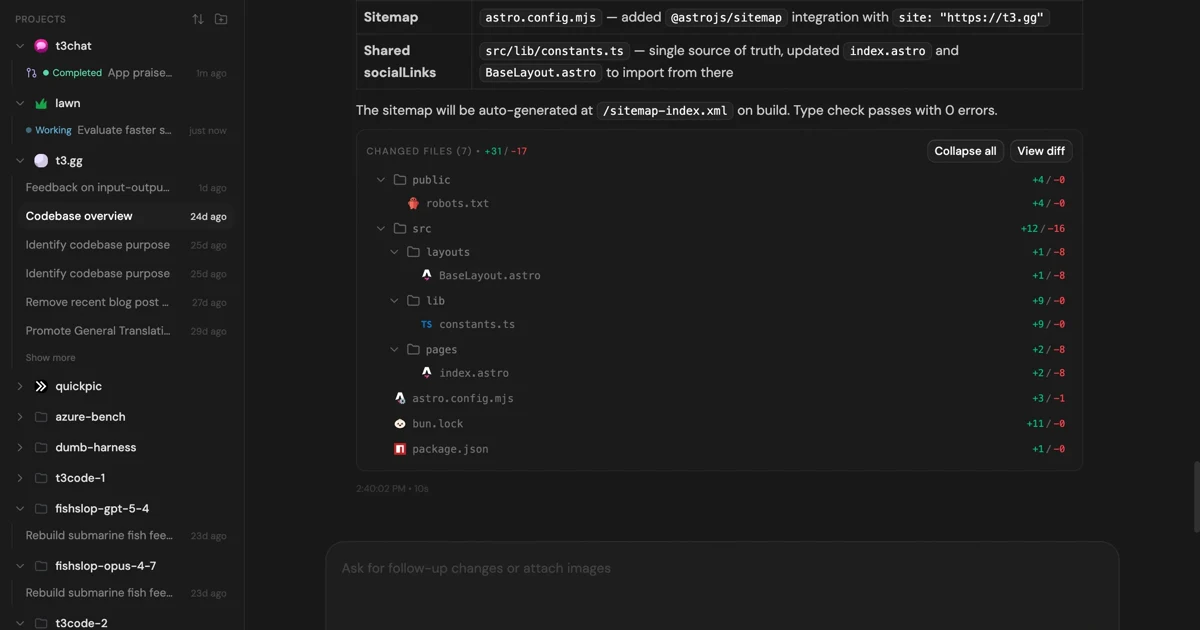
MIT-licensed control plane for running Claude Code, Codex, Cursor, Grok, and OpenCode threads from desktop, web, iOS, and Android clients.
Do one more comparison before you commit to Numbat
Strong picks usually survive one more internal check. Read deeper, compare a neighbor, then leave for the vendor page if the fit still holds.