
Ponytail
MIT-licensed agent plugin and skill that pushes coding agents toward the smallest sufficient implementation without dropping safety or validation.
Do not bounce yet
Read the fit check, compare one alternative, then decide whether the vendor page is still your best next click.
Quick Verdict
Fast fit check before you leave the page
Make the fit call first. Vendor pages are good at selling, but they rarely tell you where the product is a bad match.
- Developers using Claude Code, Codex, GitHub Copilot, OpenCode, Qoder, Pi, Gemini CLI, Hermes Agent, or another supported coding-agent host
- Teams trying to reduce unnecessary code, dependencies, wrappers, and speculative architecture in agent-generated changes
- Reviewers who want explicit simplicity checks for diffs and repositories without replacing their existing coding agent
- The core idea can be summarized briefly, and Hacker News commenters questioned whether the large multi-host package adds enough value beyond a concise prompt.
- Published performance results are maintainer-run on one repository, task set, model, and small sample, so they do not establish universal productivity or cost gains.
- Host-specific plugins and lifecycle hooks increase installation and trust surface compared with copying a static project instruction.
Compare Next
Take one more internal step before the vendor pitch
This is where visitors usually jump out too early. Read one deeper take or open one alternative so the next click is informed instead of impulsive.
Alternative profile
Better Harness
MIT-licensed workflow-inspection plugin that turns coding-agent project and session evidence into prioritized, verifiable improvements.
Alternative profile
Superpowers
MIT-licensed skills framework and software-development methodology that makes Claude Code, Codex, Cursor, OpenCode, Pi, and other coding agents follow spec, TDD, review, and branch workflows.
Alternative profile
Skills for Real Engineers
MIT-licensed bundle of composable engineering skills for Claude Code, Codex, Cursor, and other Agent Skills-compatible coding agents.
Ponytail is an open-source plugin and skill layer that asks coding agents to stop at the simplest implementation that satisfies the task. Its ladder starts by questioning whether code is needed, then favors reuse, the standard library, native platform features, and existing dependencies before allowing new implementation. Host-specific adapters bring the same policy to Claude Code, Codex, GitHub Copilot, Pi, OpenCode, Qoder, Gemini CLI, Hermes Agent, and other environments, while review and audit commands apply it to existing work. That is directly relevant to vibe coding teams struggling with agent-generated bloat, but the package should be evaluated as opinionated workflow guidance rather than a proven universal optimizer.
Ponytail is an open-source “lazy senior developer” layer for coding agents. It adds a seven-rung decision ladder—skip unnecessary work, reuse the codebase, prefer standard-library and native platform features, reuse installed dependencies, and only then write the minimum new code—through plugins, hooks, skills, and commands for Claude Code, Codex, GitHub Copilot, Pi, OpenCode, Qoder, Gemini CLI, Hermes Agent, and other hosts. Review and audit commands target over-engineering in diffs and repositories, while configurable lite, full, and ultra modes control how strongly the guidance intervenes. The project is inspectable and unusually well adopted for its age, but its benchmark is maintainer-run and Hacker News discussion questioned whether the large multi-host package provides enough value beyond a concise prompt; teams should pilot it against representative tasks and keep project tests and human review authoritative.
Why Choose Ponytail?
Choose Ponytail when coding agents routinely add speculative abstractions, wrappers, dependencies, or configuration that the requested change does not require.
Its differentiator is a small explicit decision ladder packaged across multiple agent hosts, with review and repository-audit commands for work that already exists.
The MIT-licensed implementation, tagged releases, tests, and benchmark artifacts are inspectable and can be pinned for team review.
Do not treat maintainer-run benchmark reductions or repository popularity as universal evidence; compare it with a concise project instruction on representative tasks and keep tests and human review in control.
Key Features
Applies a seven-rung simplicity ladder before new code is written: skip, reuse, standard library, native platform, installed dependency, one line, then minimum custom implementation.
Offers lite, full, ultra, and off modes plus a persisted default so teams can tune how strongly the guidance intervenes.
Provides diff review, repository audit, deferred-debt tracking, benchmark-scoreboard, and help commands.
Ships plugins, hooks, skills, and adapters for Claude Code, Codex, GitHub Copilot, Pi, OpenCode, Qoder, Gemini CLI, Hermes Agent, and additional hosts.
Keeps validation, security, accessibility, error handling, and data-loss protection outside the code-cutting target.
Publishes maintainer-run benchmark configuration, task results, controls, corrections, and limitations for inspection and reproduction.
Pros & Cons
- Targets unnecessary implementation and dependency growth without replacing the coding agent or model.
- MIT-licensed source, pinned releases, host adapters, tests, and benchmark artifacts make the mechanism inspectable.
- Supports several major coding-agent environments with shared guidance and host-specific installation paths.
- Review and audit commands make the simplicity policy usable on existing diffs and repositories, not only during generation.
- The core idea can be summarized briefly, and Hacker News commenters questioned whether the large multi-host package adds enough value beyond a concise prompt.
- Published performance results are maintainer-run on one repository, task set, model, and small sample, so they do not establish universal productivity or cost gains.
- Host-specific plugins and lifecycle hooks increase installation and trust surface compared with copying a static project instruction.
- The project is young, and its large open issue and pull-request queues make raw popularity difficult to translate into maintenance quality.
Detailed Use Cases for Ponytail
Run a fixed decision ladder that favors no code, repository reuse, standard libraries, native capabilities, and installed dependencies before custom implementation.
Use Ponytail’s review command to identify unnecessary abstractions or dependencies while preserving required correctness and safety work.
Scan an existing codebase for avoidable bloat and separate actionable simplification from intentionally deferred debt.
Apply the same simplicity guidance through host-specific plugins, hooks, and skills across several coding-agent environments.
Who Should Use Ponytail?
Developers using Claude Code, Codex, GitHub Copilot, OpenCode, Qoder, Pi, Gemini CLI, Hermes Agent, or another supported coding-agent host
Teams trying to reduce unnecessary code, dependencies, wrappers, and speculative architecture in agent-generated changes
Reviewers who want explicit simplicity checks for diffs and repositories without replacing their existing coding agent
Engineering leads willing to evaluate opinionated agent guidance against project-owned tests, security requirements, and human judgment
Perfect For
Reduce speculative abstractions, wrappers, and dependencies in agent-generated feature work.
Review a current diff for over-engineering while preserving required validation, security, and accessibility.
Audit an established repository for avoidable complexity and record intentionally deferred cleanup.
Apply one simplicity policy across teams that use several different coding-agent hosts.
Technical Details
Direct Competitors
Skills for Real Engineers
Superpowers
Better Harness
Caveman
project-specific AGENTS.md or CLAUDE.md guidance
Similar Tools You Might Like
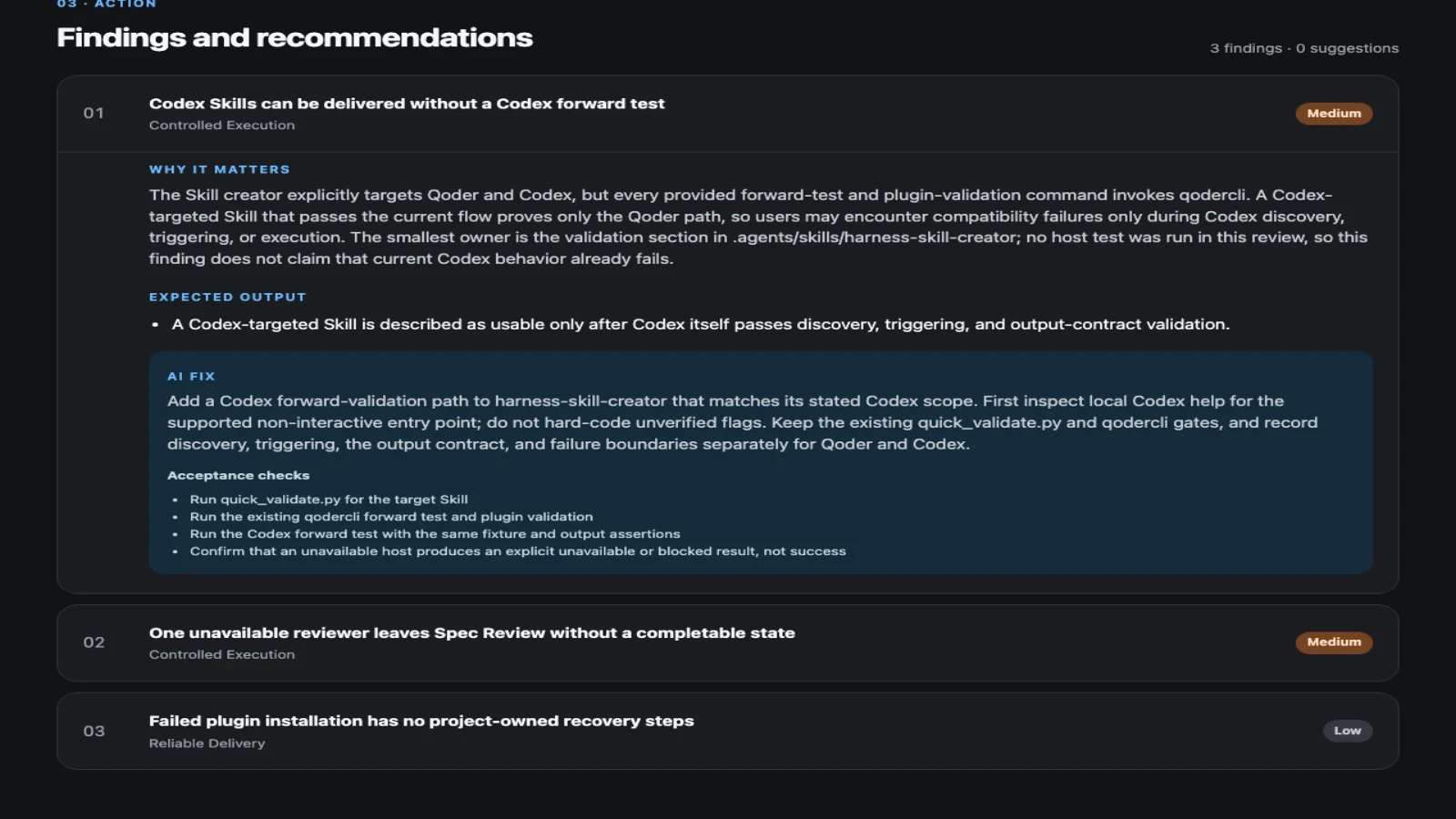
MIT-licensed workflow-inspection plugin that turns coding-agent project and session evidence into prioritized, verifiable improvements.
MIT-licensed workflow plugin that gives Claude Code, Codex, Cursor, OpenCode, and other coding agents a plan-work-review-compound engineering loop.

MIT-licensed skills framework and software-development methodology that makes Claude Code, Codex, Cursor, OpenCode, Pi, and other coding agents follow spec, TDD, review, and branch workflows.
Alternative Tools to Consider
MIT-licensed workflow-inspection plugin that turns coding-agent project and session evidence into prioritized, verifiable improvements.
MIT-licensed skills framework and software-development methodology that makes Claude Code, Codex, Cursor, OpenCode, Pi, and other coding agents follow spec, TDD, review, and branch workflows.

MIT-licensed bundle of composable engineering skills for Claude Code, Codex, Cursor, and other Agent Skills-compatible coding agents.
Do one more comparison before you commit to Ponytail
Strong picks usually survive one more internal check. Read deeper, compare a neighbor, then leave for the vendor page if the fit still holds.