
Agent Deck
Open-source terminal session manager for running and supervising multiple AI coding agents across isolated git worktrees.
Do not bounce yet
Read the fit check, compare one alternative, then decide whether the vendor page is still your best next click.
Quick Verdict
Fast fit check before you leave the page
Make the fit call first. Vendor pages are good at selling, but they rarely tell you where the product is a bad match.
- Developers already using Claude Code, Codex, Gemini CLI, OpenCode, Aider, or similar terminal agents
- Builders running several tasks in parallel on the same repository who need stronger branch isolation and session awareness
- Infra-minded teams that prefer local, inspectable orchestration over another hosted browser-only control layer
- This is still a terminal- and tmux-heavy workflow, so it is not the right entry point for developers who want a polished beginner UI.
- Core host support is centered on macOS and Linux, with Windows effectively meaning WSL rather than a clean native experience.
- Agent Deck orchestrates upstream coding agents instead of replacing them, so quality, permissions, and model costs are still inherited from whatever you plug into it.
Compare Next
Take one more internal step before the vendor pitch
This is where visitors usually jump out too early. Read one deeper take or open one alternative so the next click is informed instead of impulsive.
Related article
Agent Deck Review 2026: Terminal Command Center for Claude Code, Codex, Gemini, and OpenCode
A practical Agent Deck review covering official links, installation, git worktrees, conductor workflows, pricing reality, public traction, risks, and alternatives.
Alternative profile
Agent of Empires
Open-source terminal and web session manager for running multiple AI coding agents across isolated git worktrees and sandboxes.
Alternative profile
Claude Squad
Open-source terminal app for managing multiple AI coding agents like Claude Code, Codex, OpenCode, and Aider across isolated workspaces.
Alternative profile
Orca
MIT-licensed agent development environment for running Claude Code, Codex, OpenCode, Cursor CLI, and custom agents in parallel Git worktrees.
Agent Deck is for developers who already know that one foreground coding agent is not a real operating model. Instead of juggling Claude Code, Codex, Gemini CLI, OpenCode, or Aider sessions across random shells, it gives you a dedicated terminal control layer with worktree isolation, status visibility, and a growing set of operational features for supervising parallel agent work.
Agent Deck is a terminal-native control layer for developers who have already hit the obvious scaling problem in vibe coding: once Claude Code, Codex, Gemini CLI, OpenCode, or Aider sessions multiply, raw terminals and shared branches get stupid fast. It gives you one TUI to launch, monitor, jump between, and organize agent sessions, adds git worktree isolation so tasks stop colliding, and keeps layering in operational details like conductors, notifications, and shared MCP socket pooling. That makes it materially more relevant than a thin launch-week wrapper because it is solving coordination and operator workflow, not pretending one more chat box is innovation.
Why Choose Agent Deck?
Choose Agent Deck when the actual bottleneck is supervising multiple coding agents sanely, not finding another autocomplete gimmick to demo.
Its worktree-first design matters because parallel agent workflows only stay useful when branch isolation is built in from the start.
Conductor flows, notification bridges, and MCP socket pooling make it more than a basic launcher; the project is thinking about real long-running operator workflows.
Because it sits on top of existing terminal-native agents instead of replacing them, Agent Deck preserves vendor flexibility while improving the control surface.
Key Features
Run Claude Code, Gemini CLI, Codex, OpenCode, Aider, and similar terminal agents from one TUI instead of scattering sessions across ad hoc terminals.
Use isolated git worktrees per task so multiple agents can work on the same repository without colliding in one branch.
Jump between waiting sessions from the tmux status line and keep operator awareness closer to the terminal instead of babysitting every pane manually.
Add conductor workflows, Slack or Telegram bridges, and transition notifications for teams that want a stronger supervision loop around long-running agents.
Share MCP processes across sessions through socket pooling so large multi-agent setups waste less memory and recover more cleanly from crashes.
Ship as an MIT-licensed open-source Go project with public releases, docs, and active iteration.
Pros & Cons
- Agent Deck is solving the real multi-agent problem: coordination, visibility, and branch hygiene, not just launching more chats.
- The worktree-first model is much saner than letting several coding agents mutate one shared checkout and hoping review saves you later.
- Support for multiple upstream agents keeps vendor options open instead of turning the orchestration layer into another lock-in surface.
- Conductor flows, notification bridges, and MCP socket pooling show operational depth that most launch-week wrappers simply do not have.
- This is still a terminal- and tmux-heavy workflow, so it is not the right entry point for developers who want a polished beginner UI.
- Core host support is centered on macOS and Linux, with Windows effectively meaning WSL rather than a clean native experience.
- Agent Deck orchestrates upstream coding agents instead of replacing them, so quality, permissions, and model costs are still inherited from whatever you plug into it.
- The feature surface is getting broad enough that teams can create complexity for themselves if they deploy it before they actually need multi-agent supervision.
Detailed Use Cases for Agent Deck
Use Agent Deck when one repository needs several agent tasks at once and you want each session isolated in its own git worktree instead of creating a self-inflicted merge mess.
Its status-line integration and session model are useful when you want to see which coding agents are waiting, running, or blocked without manually checking every pane.
Agent Deck fits teams that want named supervisor sessions, optional Slack or Telegram nudges, and a cleaner human-in-the-loop path for long-running work.
Socket pooling makes Agent Deck more interesting for builders running many agent sessions with shared MCP dependencies, where duplicate background processes become wasteful fast.
Who Should Use Agent Deck?
Developers already using Claude Code, Codex, Gemini CLI, OpenCode, Aider, or similar terminal agents
Builders running several tasks in parallel on the same repository who need stronger branch isolation and session awareness
Infra-minded teams that prefer local, inspectable orchestration over another hosted browser-only control layer
Operators who want a more disciplined workflow around long-running agent sessions, notifications, and MCP-heavy setups
Perfect For
Running several coding agents on one repository while keeping each task isolated in its own git worktree.
Supervising long-running terminal-native agents without losing track of which session is waiting, blocked, or ready for review.
Routing work through named conductor sessions and receiving Slack or Telegram nudges when child sessions change state.
Reducing MCP overhead in heavier agent setups by pooling processes instead of duplicating the same background services per session.
Technical Details
Direct Competitors
Claude Squad
Agent of Empires
Orca
Superset
Similar Tools You Might Like

MIT-licensed local memory server and CLI for carrying coding context, summaries, and handoffs across Claude Code, Codex, Cursor, OpenCode, and other agent clients.
MIT-licensed codebase knowledge graph and MCP server for structural search, natural-language exploration, data-flow tracing, and agent-assisted edits across mixed-language repositories.
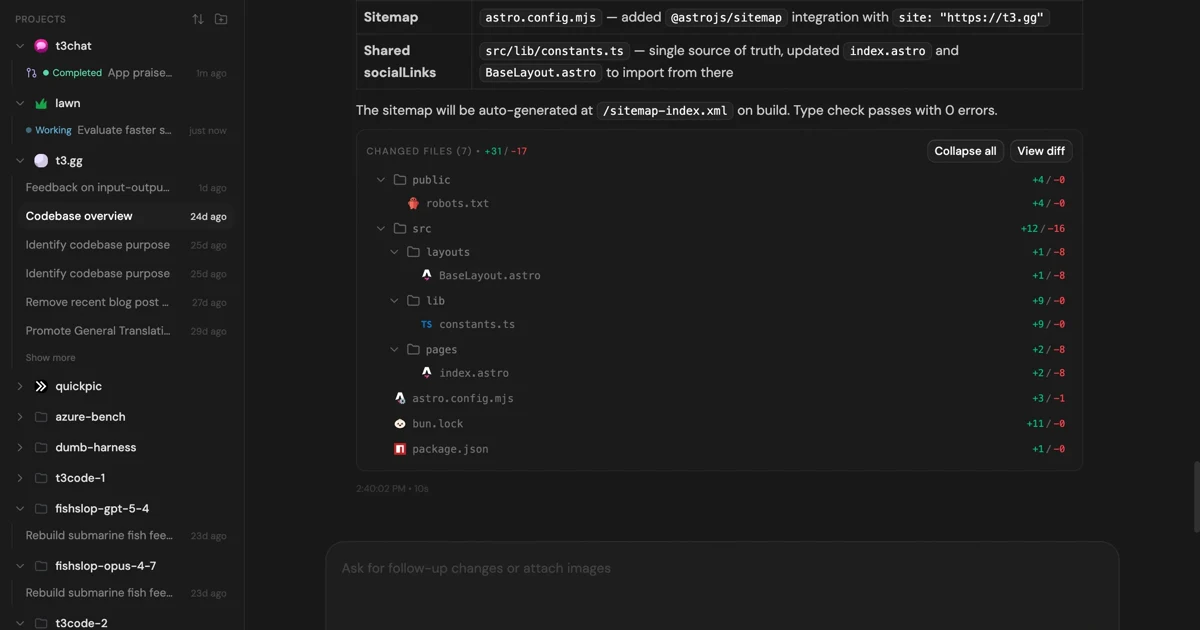
MIT-licensed control plane for running Claude Code, Codex, Cursor, Grok, and OpenCode threads from desktop, web, iOS, and Android clients.
Alternative Tools to Consider

Open-source terminal and web session manager for running multiple AI coding agents across isolated git worktrees and sandboxes.

Open-source terminal app for managing multiple AI coding agents like Claude Code, Codex, OpenCode, and Aider across isolated workspaces.

MIT-licensed agent development environment for running Claude Code, Codex, OpenCode, Cursor CLI, and custom agents in parallel Git worktrees.

Minimal terminal coding harness with extensions, skills, tree-structured sessions, and serious multi-provider model support.

Worktree-based macOS editor for running and reviewing multiple CLI coding agents like Claude Code, Codex, Gemini CLI, and OpenCode in parallel.
Do one more comparison before you commit to Agent Deck
Strong picks usually survive one more internal check. Read deeper, compare a neighbor, then leave for the vendor page if the fit still holds.